|
Abbreviated passages from PART 2 of
Who is Crazy,
actually?
-
Transference and countertransference: of all
time
-
Examples of transference and countertransfererence
Proximity:
A warm bath of mutual affirmation
Proximity:
Salvation
Dangerous pity (book by Stefan Zweig)
Distance:
A cold wall
Haughtiness:
Indispensable
Powerlessness:
An angry therapist
Inferiority:
A jealous therapist
Power and manipulation:
Sexual abuse by a
therapist
Note: The case descriptions in these examples are
based on conversations with former clients about their experiences in the
Dutch mental health care. Names and personal details have been changed to ensure anonymity.
After the passages from Who
is crazy, actually?
follows:
-
Theoretical knowledge is not sufficient for professional
mental health
care:
A disciplinary case about countertransference
by a trauma expert.
The client: "Confused"
Whimsical
-
"A
PATIENT GETS NO FURTHER THAN HIS THERAPIST"
No matter how loyal the client is and how much he or she trusts the expertise
of his/her
therapist, a therapist is only human: the therapist does not always possess all the wisdom, and nothing human is alien to him or her. Consequently, the responsibility for stagnant or failing care may lie with the care provider.
In
Part 2 of
Who is crazy,
actually?, titled
The therapist on the
couch, Saar Roelofs demonstrates that the conventional dividing line between the 'healthy'
therapist and the 'sick' client is sometimes very thin. Using the concepts of
transference
and
countertransference, she explains how a treatment can go wrong.
Then there is a risk that the client's psychological problems will not decrease but
increase. In that case, the client has become entangled in the mental
health care. However, even if both
therapist and client are satisfied with the therapeutic relationship, this does not necessarily mean that the care is of good quality.
Neutral empathy. For a good therapeutic relationship, a
therapist must be capable of empathy. That is to say: the
therapist must be able to temporarily empathize with the client's inner world while maintaining distance and observational skills. The
therapist avoids being too involved or, conversely, too distant, and ensures that his or her personal life does not interfere with the therapeutic process. Within this so-called neutral empathy, the therapeutic relationship is carefully defined. The duration, frequency, and location of treatment are fixed. The division of roles is described: the client asks for help, the
therapist gives help and maintains an overview. In short: the boundaries within which the therapy takes place are delineated. However, this is often not the case due to the phenomenon of
countertransference.
Transference.
First, something about the phenomenon
of transference. Transference occurs when a client harbors feelings towards the
therapist without the
therapist giving any reason for doing so. These can be undeserved positive feelings, such as idealization and infatuation, or unfounded negative feelings, such as fear and anger. As a rule, these feelings can be traced back to childhood experiences
- as if the client is transferring the feelings he or she had as a child towards his or her parents or other key figures (such as grandparents, teachers, or siblings) onto the
therapist.
Countertransference.
When the therapist loses his or her neutral empathic position, countertransference plays a role in the treatment. There are various definitions of countertransference. The most conservative definition is: any reaction by the therapist that aligns with the client's transference and adversely affects the therapeutic process. Some examples:
The client sees his/her
therapist as a loving mother.
The therapist responds to this with affection and care.
The client projects his/her authoritarian father onto his
therapist.
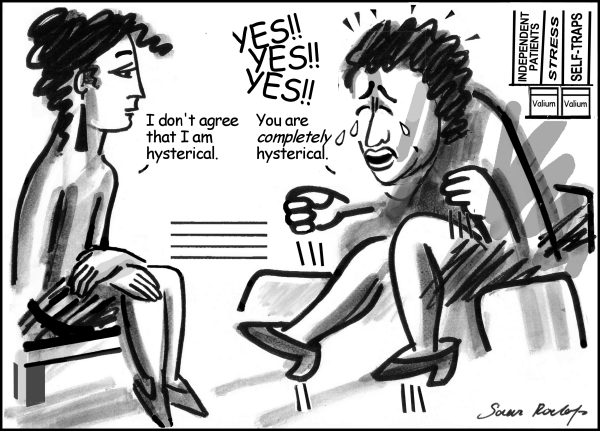
The therapist reacts to this with frustration. The client behaves as if the
therapist is his younger brother and belittles him.
The
therapist reacts to this with insecurity.

Instead of remaining neutral, the
therapist - out of a sense of concern, resentment
or insecurity
- allows himself or herself to be
drawn into the client's reactions and thereby reinforces them.
Consequently, the reactions of the therapist have a detrimental effect on the therapeutic process.
In a broader definition, countertransference refers to all reactions of the
therapist that impede neutral empathy. For what applies to the client also applies to the
therapist: the therapist was once a child too and may
- just like his or her client - have suffered under unloving parents and long for someone who sees, understands, and respects
him/her. The therapist, too, may struggle with unresolved fear, grief
and anger. If the
therapist fails to acknowledge these feelings,
he/she may project them onto their client without realizing it.
Neutral empathy can also be disrupted by positive or negative feelings originating in the
therapist's daily life. For example, if
he or she lacks love after a divorce or if the affection from children leaving home diminishes,
the therapist may have a greater need for appreciation than usual. Or, if
he or she is overburdened or exhausted, the
therapist may react distantly to the client.
EXAMPLES
In Who
is crazy,
actually? Saar
Roelofs explains in detail, using many examples, how unresolved
emotional problems of therapists themselves can disrupt or block the
therapeutic process. In
doing so, she categorizes countertransference into three broad,
arbitrary categories; categories that are not mutually exclusive:
Proximity and
distance
Example of proximity: Overstepping the client's
boundaries.
Example of distance: Anxiety for the the client's problems.
Haughtiness and inferiority
Example of haughtiness: A sense of infallibility on the part
of the therapist.
Example of
inferiority: Jealousy of the client.
Power and powerlessness
Example of power: Verbal dominance over the client.
Example of powerlessness: Arguments with the client.
|
Proximity: A warm bath of mutual affirmation
Ideally,
the client receives attention and respect from the
therapist. The client is usually grateful for this. There
is a chance that he or she will begin to idealize the
therapist. A skilled therapist knows and recognizes this
phenomenon. He/she refuses to accept the idealization of
his/her client, however pleasant it
may be. The therapist maintains his or her neutral
position by gently curbing the client's positive
transference. However, when the otherapist has not sufficiently
processed his or her own lack of parental love or
experiences too little love in daily life, there is a
chance that the therapist is blind to the client's
transference. In that case, he or she feels flattered by
the client's affection and feeds on the positive
transference: at last someone who appreciates him or her
and values his or her work. Thus, the therapist can
become dependent on his or her client and even subtly
stimulate the client's feelings of transference.
In the
example below, the client's transference aligns seamlessly
with the therapist's countertransference. Everything seems
fine, while in fact there is a mutual dependency that
harms the therapeutic process.
When
Carin is four years old, she gets a little brother. The
child is sickly. Carin's mother gives him all her
attention. When he dies after a year, the mother is
inconsolable and withdraws emotionally. Due to her
brother's illness and death, Carin receives insufficient
attention and affirmation. Carin senses her mother's
distress and tries to be as little of a burden to her as
possible. She develops into a compliant and insecure girl.
With her
female therapist, Carin receives the attention she craves. This
enables her to express feelings she shies away from
outside the therapy room. She is good at allowing sadness
and fear, but struggles to express her feelings of
powerlessness and anger. Carin makes no secret of her
gratitude towards the therapist. The therapist is charmed
by Carin's appreciation and, without realizing it,
encourages it. For instance, she regularly hints that
Carin is her favorite client, noting that other clients in
therapy are not making as much progress. She also
occasionally lets slip how proud she is of her
self-confident young adult daughters, thereby suggesting
that she is a good mother. These subtle signals reinforce
Carin's idealization.
However,
the therapist is unaware of her manipulations. Her own
insecurity and need for appreciation blind her. Carin
intuitively senses her therapist's needs. She does what is
expected of her, just as she met her mother's wishes as a
child.
With a
needy therapist and an idealizing client, the therapy
degenerates into a bond of mutual affirmation, of an ideal
mother and an exemplary child. In this comforting bath of
mutual affection, Carin fails to process the repressed
anger and powerlessness regarding the chronic lack of
attention in her childhood. On the contrary. She brings
the compliant child from her youth back onto the stage.
Thus, the therapist is co-responsible for the perpetuation
of Carin's psychological issues.
|
|
Proximity: Salvation
There
are therapists who are so committed to their client that
they want
to relieve him or her of all pain and sorrow. Especially
if that client is in the the
eyes of the therapist bears great suffering. In
compensation for the pain suffered in the past, he or she
wants to give the client what he/she never and can
never give: a present in which all suffering has past and
pain no longer exists. The example below shows how the
therapist takes
control of her client's life and how professional boundaries
blur as a result.
As a
child, Ronnie felt lonely and unhappy. As a young woman
she was deported to the Nazi concentration camp Auschwitz
and she
barely survived that. Upon returning, she ends up in a cold
marriage. After a divorce, she decides to seek treatment
for her childhood and war traumas. Ronnie speaks with
appreciation about
her therapist:
She had many Auschwitz survivors in therapy and knew
the camp down
to the finest details. For example, if I said: the
Lagerstrasse or Block 29 then
she knew exactly what I was talking about. I
was able to talk a lot about my fears in the camp. I also
shed many tears over my terrible childhood and my mother's
cold behavior upon my return from the camp. With my
therapist I found the warmth, understanding and trust
that I had always missed so much. I could cry my heart out
with her.
I could always call her, whenever and
anywhere.
Even at night. I was happy to take advantage of that. For
example, when I was once very upset, I called her
at
two o'clock in the morning. She
said: “You know what? Put something on over your pajamas.
I’ll
send a taxi and just come here then.” I then
spent the whole night sitting
with her, talking and crying.
Like
more therapists who work with severely traumatized
clients, Ronnie's
therapist cannot bear to see her client's pain. She is constantly
available like a mother for her child. She wants her be
able to relieve the client of her momentary pain at any
moment. She wants to undo the impact of her client's
traumas. She believes she is offering help. To
be selfless or generous. But, however well-intentioned,
the client
does not benefit from it. A skilled therapist knows that a
client is responsible for his or her own life and makes
his/her own choices. That the relentless care is addictive
and causes the client more harm than good. He or she gives
his/her client – within the therapeutic context –
merely means in hand to change his own life. A
therapist who is on standby day and night will – for
whatever reason
- inevitably be forced to discontinue the treatment
sooner or later.
And when that
moment arrives, the therapist risks turning from a helper
into an 'perpetrator' in the client's eyes.
|
Dangerous pity
In his novel Ungeduld
des Herzens from
1939, Stefan Zweig (1881–1942) describes in a
beautiful and poignant way how dangerous the unwavering care for
another can be. Zweig, who lived in Vienna for
a long time, was impressed by the work of his fellow townsman Sigmund Freud and
wrote several psychological novels. Ungeduld
des Herzens (Impatience
of the heart)
is
one of his best.
In France, the book was published under the title La
pitié dangereuse
(Dangerous
pity),
a title that covers the content well.
The main character
in the novel is Anton Hofmiller, a friendly and sensitive
twenty five year old lieutenant stationed in a Hungarian garrison town
shortly before the outbreak of the First World War. Hofmiller receives
an invitation to a dinner at a neighboring castle, where he asks Edith,
the seventeen year old daughter of the house, to dance. However, he does not
see that her legs are paralyzed. Hofmiller feels pity with the girl, and
to make up for his blunder, he visits her a few times.
Edith brightens up so much from this that Hoffmiller is surprised. He
realizes that his comfort gives him power. From that moment on his life takes a
turn. He experiences it as a lofty goal to be of service to
others. That experience gradually grows stronger and soon he derives the
meaning of his existence from it.
What? Even I, a
mediocre young man, had power over other people? (…) I,
Lieutenant Hofmiller, could help someone, I could comfort someone? (…)
What had I actually done? I had a little showed pity (…) and
that would have been enough. (…)
Just this intention
alone, to help and from now on be useful to others arouses a
kind of enthusiasm in me. (…) Only, as soon as one knows that one is
something to others as well, one feels a sense of purpose and mission one's own existence.
His pity, however,
is not without danger. It is addictive, not only for himself,
but also for Edith. Without Hofmiller noticing, the girl
falls passionately in love with him. Edith's the attending
physician explains to him:
Only in the
beginning is pity – just like morphine – a blessing for the sick, a
medicine, a remedy, but when one does not
properly know how to determine the dose and when to stop, it becomes a deadly
poison. With the first few injections, one does good, those soothe,
they lessen the sorrow. But tragically enough, the organism, the
body as well as the soul, possesses a terrifying
adaptability; just
as the nerves need more and more morphine, feeling needs more
and more pity, and
finally more than one can
give. Inevitably, there comes a moment, then and there, when one must
say 'No' and not care whether the other person hates us more for this
final refusal than if we had never helped them at all. Yes, dear
lieutenant, one must keep one's pity
well in check, otherwise
it causes more damage than all
indifference.
Hofmiller, however,
cannot resist Edith's compelling emotional appeal. For, as Stefan Zweig
notes, it is precisely the "marked", "deformed" and "excluded",
those who, like Edith, have no chance and hope, desire with a
"fanatical and dark passion". The lieutenant even gets engaged to
Edith against his will. In front of his comrades, he
denies the engagement. When this comes to Edith's ears, she ends her life.
to top
|
Distance: A cold wall
Sometimes a therapist is so consumed by his or her own
theoretical premises that he/she loses sight of the
client. Within psychoanalytically oriented therapies, for
example, transference and countertransference are core
processes in the treatment. In such cases, it is essential
that the therapists reveals as little of himself or
herself as
possible so that the client's transference is maximized.
The well-known caricature of the 'humming therapist' can
be traced back to this. However, some therapists are very
strict about maintaining the proper distance they are
supposed to keep.
Sophie
is in therapy with a therapist who is trained in
psychoanalysis. He takes his job extremely seriously.
Sophie recounts: "He sat with his arms tightly crossed.
Cold and distant. A mouth like a straight line. He didn't
ask me anything and just sat there interpreting things.
Hm… hm…, this means this, that means that, right, then we
are dealing with this and that. He didn't even look at me.
I felt like I was talking to a wall. When he went on
vacation once, I asked politely: where are you going? To
which he replied: that is none of your business. I was
perplexed! I thought: do you think I want to come along?!
Come on, surely it can be a little personal. Not so
sterile. I need human contact. But I didn't dare say
anything about it. He was too cold for that."
|

Distance: Therapist (r) afraid of the client's problems
|
Haughtiness:
Indispensable
It
happens quite often that the therapist views the
client as dependent and immature, and attributes to
himself or herself a central role in the client's life. An example.
Max
starts therapy due to persistent depression. After the intake,
he is on a waiting list for a long time. During the
waiting period he
gathers all his strength and deploys a number initiatives. When
the treatment begins, he feels a lot better. However, the
therapist is convinced that Max is not doing well. She
considers it impossible that Max has recovered without her
help.
|
|
|

|
|
|
Powerlessness: An angry therapist
For a
therapist, it can be difficult to accept when a client
criticizes the treatment. After all, he or she is making
an effort for the client and wants appreciation for
his/her dedication.
Kurt
initially basks gratefully in the warm interest of his
male therapist. But over time, he feels increasingly
uncomfortable. He even starts to dread the sessions. The
therapist begins to irritate him. His exaggerated diction
doesn't appeal to him. Actually, quite an arrogant jerk,
Kurt thinks. When he is late for
his weekly appointment, the therapist kindly asks him to
arrive on time in the future or -
if that is not possible - to cancel
the appointment. Exactly like my father,
Kurt thinks. Always making remarks about the
slightest thing. And he gives the therapist a piece of his
mind. After an initial idealization, Kurt
perceives his therapist as the spitting image of the 'bad'
parent, his authoritarian father.
The
therapist loses sight of the fact
that he is serving his client when, within pre-agreed
ground rules, he acts as a projection screen for his
client's frustrations. That he is temporarily his
surrogate father (or mother). As a result, he takes his
client's criticism personally. He feels hurt and rejected.
Eventually, he becomes defensive and even gets angry. 'All
well and good, but I won't let myself be insulted.' 'I
have my limits too. I won't take this.' Examples of
powerlessness that prevent Kurt
from processing his pain regarding his father's
authoritarian behavior in the treatment room.
|
| |
 |
|
|
|
Inferiority: A
jealous therapist
Therapists who do their job well usually enjoy it. For
example can a care provider take pleasure in the fact that
he or she brings a client back
into contact with his inner resilience. To see someone
flourishing
can be inspiring. But therapists are also sometimes jealous.
Envious of their
client's sporting, intellectual, or artistic achievements,
or their social success,
amorous adventures or
beautiful appearance – on things in which the client
distinguishes himself from others,
of whom he or she is proud.
Whoever
respects his or her own individuality can also appreciate
others for who they are. However, whoever is dissatisfied
with himself or herself, whoever feels insecure or
inferior, is inclined to compare themselves to others.
Then jealousy lies lying
in wait.
A
therapist will not to
be quick to envy as long as the client is worse off than
he or she is. That
is usually the case when the client signs up for therapy.
Afraid, sad or desperate, the client seeks support and
and thereby adopts a dependent position. But people who
decide to go into therapy,
are not exclusively pathetic bundles of misery. Everyone
has strong and
weaker sides. Someone who is undergoing treatment for relationship
problems, for
example, can function excellently at his work. When
a therapist becomes jealous of his or her client, it is
not inconceivable that he or she – instead of emphasizing
the client's vitality – sundermines
the client's self-confidence.
Downplaying the client's performance
Here is
an example of a therapist who
downplays his client's performance when it borders on his
own area of expertise.
Carl
is in therapy for recurring feelings of depression, which
alternate with periods of euphoria. He has been receiving
treatment for this for years and has also been admitted to
a psychiatric hospital. He has written a personal document
about his experiences in psychiatry. Excited,
Carl tells his male therapist that the book was discussed
favorably on the radio. In particular the clear way
in which he mapped out his psychological problems, was
praised. Not only useful for clients, but also for
therapists, so
it was said. The therapist's reaction is: "Yes, yes, nice. Given
my busy practice, I certainly don't have the time to write
such information booklets myself."
Therapists
have a preference for verbally gifted, well-educated clients.
However, when the client is more
highly educated than the therapist, a feeling of envy can
strike that translates into arrogance. The
following examples of envy are not included in Who
is crazy, actually? but are still worth mentioning:
Superior
due to a past life
A university-educated
client tells his
therapist that he has published a book. To which the
therapist nonchalantly replies: "Oh, I already wrote
books in my previous life" -
a reaction as absurd as it is comical.
Triumph
A
therapist once triumphantly recounted that she had made a
professor cry. Not because she was delighted that the man
had experienced a significant therapeutic breakthrough,
but because she possessed the power to render even an
influential person like a professor defenseless and small.
She felt superior to him because, in her eyes, with all
his knowledge, he was deep down "a pathetic mess", whereas
she herself, by her own account, was "mentally healthy".
Thus, she displayed not only rivalry but also a
bewildering lack of empathy.
|
to top
|
Power
and manipulation: sexual abuse by a therapist
The
slippery slope
It is
obvious to anyone that a therapist is not allowed to enter
into a sexual relationship with the client. Yet it
happens. Sexual abuse is a serious form of
boundary violation. Usually, this does not
happen overnight. The lead-up to the abuse can be
long and usually proceeds step by step. For example, it
might start with a handshake that is just a little too
long and a sultry glance at the farewell. A
while later, the handshake can turn into a hug. Or
the therapist starts talking about himself or herself in
the treatment room, lets the session run over, or suggests combining the
session with a shared lunch. He or she gives and accept
gifts or offer the client a ride
home. The client may feel flattered by this, believing that
the relationship is becoming equal. When the client goes
along with the first step, it is difficult to refuse the
next. If you say 'A', you have to say 'B'.
During treatment, the client places so much trust in the
therapist that a unique bond develops. If the
therapist also claims to care deeply about
the client, it becomes increasingly difficult for the client to
stay outside the therapeutic twists and turns. This is
referred to as the slippery
slope, the
slimy incline of boundary-crossing behavior down
which the client slides until sexual contact becomes a
reality.
Below
follows the
poignant
account of a young woman who is manipulated and
sexually abused by her therapist within the
four walls of the treatment room, behind the closed door
with the DO NOT DISTURB sign.
Severe
childhood traumas. Ingrid
grows up as an only child in a small provincial town with
a mother suffering from recurring psychotic delusions. Her
father travels frequently for business. From an early age,
Ingrid has to ensure
that her mother remains more or less emotionally balanced.
As a toddler,
she develops a radar for her mother's fears and regularly
takes her by
the hand to reassure her. She becomes her
mother's confidante, pillar of support and comforter – a
'little angel,' as
her mother calls her. In doing so, Ingrid secures 'love'. However,
at the most unexpected moments, she is accused
by her mother of things she did not do. Then her
mother rages and rants, and sometimes beats her roughly.
Ingrid cannot reconcile
the two: one moment she is a little angel, the next she
is being thrashed. It is as if she has two mothers: a
sweet one and an angry one. Ingrid cannot live with that.
When her mother becomes
violent, she splits off her feelings of fear and
powerlessness and
switches off her emotions. When Ingrids father returns
home from business trips, he takes over his wife's false
accusations.
Small as she is, Ingrid is completely on her own. She lacks
so much parental love that she develops
a chronic craving for love and validation. Growing up, she
can no longer imagine that love without fear,
pain, and self-denial exists. She automatically slips into
the role of helper. In that role, she feels 'normal'.
In
therapy.
During her training as a social worker, Ingrid suffers
from burnout and experiences severe
concentration problems. Sometimes she sits
dozing over her books for hours. Afterwards, she no longer
remembers what was going through her mind.
With these complaints, she registers at a psychological group practice.
Appreciation. Therapist
Rob takes her into treatment. Ingrid likes him.
After four sessions, Rob invites Ingrid's parents for a
few conversations. Afterwards, Rob expresses his
admiration for the empathetic way Ingrid
treats her mother. According to him, she would make
an excellent therapist. The roles could just as easily be reversed, he
thinks - she the therapist and he the client - because he
himself also
had a difficult childhood. Ingerid finds this remark a
little strange. But Rob's appreciation drowns
out her second thoughts. She feels flattered
and regains some self-worth.
Mutual
love. Rob's
warm voice and compliments evoke feelings of love
in Ingrid. The yearning for the ideal parent she never had begins
to take its toll. When she hesitantly confesses her
feelings to Rob, Rob, in turn, says that he is
in love with her. That such things can happen in therapy
and that it is no problem at all. That it
does not stand in the way of good treatment. The therapy
continues as usual. It is not discussed anymore. Ingrid leaves
it at that. For, as she says: "I assumed that a therapist
would not do anything that could harm a client. At that
time, I actually still thought that Rob was a good
therapist. I had an ideal image of a therapist. A
therapist is honest, wants the best for you, knows
everything about his profession, and you can
rely on him. In short, I saw a lot of beautiful things in
him that weren't there."
Sexual
abuse. Ingrid
remenbers: "Without me realizing it, he was slowly
working towards abuse. I remember, for instance, that he
once tried to put me under hypnosis. I was
lying on the floor. He was sitting over me,
bent over me. I remember not feeling safe.
That I thought: something isn't right here. He must have
looked at me in a certain way. But then again, I thought,
hypnosis is new, that's why it's scary.
I quickly dismissed my doubts. Because I
trusted him unconditionally."
When
Ingrid goes to out of town for a few weeks for a course, Rob
takes her in his arms long and tenderly as they say
goodbye. This confuses her. She wants to talk
to Rob about it. The conversations are warm
and intimate. The consequences are inevitable. Ingrid ends
up in bed with Rob.
Manipulation and isolation. During
her stay out of town, she longs for nothing but Rob.
When she returns, she starts an affair with him. Rob
becomes number one in her life. She neglects her studies
and becomes isolated. Gradually, Rob begins to control her
emotional life. He violates professional codes all the
more by keeping Ingrid
in therapy.
"During
the treatment at his practice, we sat on a couch, holding
hands and kissing while talking about our relationship. I
often thought: oh, if the health insurer only
knew about t his. The community is paying for this. This
cannot be! That is why I wanted to stop the
therapy. Rob was shocked by that. Then he started
manipulating: if you stop, I don't know if
you will still see me privately. If we continue, you
can be sure that we will see each other every week."
Fear of
not being believed. That
is how Rob keeps Ingrid trapped in 'therapy'. Within the
therapeutic relationship, she is still a
'client' and he has control over her. Should the
relationship come to light, Rob can hide behind a
pseudodiagnosis. As a therapist he could say that Ingrid
suffers from delusions and is making it all up. Ingrid
senses this intuitively. After all, as a child, she was
often falsely accused by her mother. And who believed her
back then?
Sadistic
tendencies.
With all her might, she ends the 'therapy'. But
Rob cannot do without Ingrid and visits her at home. Due
to her bottomless need for love and
validation, Ingrid is unable to resist. They
continue their relationship. Rob reveals himself to
be a man with sadistic tendencies. At one moment he is
tender, at another cruel. In
this, he resembles Ingrid's mother. Ingrid tries to
ward off her feelings of fear and powerlessness with
dissociation, just as she did as a child.
The
therapist is struggling with unresolved traumas. Rob
and Ingrid call each other every evening. From the long
phone conversations, it becomes clear that
Rob, too, suffered under a mentally disturbed mother. With all
her might, Ingrid tries to support him. The roles are
now completely reversed, just as was the case with her
mother: Rob is the client and Ingrid the therapist. In
this way, Ingrid tries to make Rob a good parent.
Finally,
a competent therapist. After
the 'therapy' ends, the relationship lasts another six
months. Then Ingrid is able to break free
from Rob and enters therapy with a competent
and experienced woman. This woman does not condone Rob's
behavior but understands Ingrid's conflicting
feelings towards him. When Ingrid occasionally projects
the 'bad mother' onto her, she maintains her neutral
empathy. During treatment, Ingrid gets a grip on what
happened to her - in the relationship with Rob and in her
childhood. She learns to 'mentalize,' to
reflect on her feelings, desires, and thoughts,
and on how they originated. Thus, she learns to
distinguish between what belongs to her traumatic
childhood and what belongs to the present. However,
it takes a long time before she fully realizes
the drama with Rob. Eventually, she understands that Rob,
as a form of countertransference, projected
his frustrations towards his mother onto her and took
advantage of her need for attention and
validation.
|
to top
©
Saar Roelofs (2008).
Text and cartoons are protected by Pictoright
|
In late 2019,
a disciplinary case involving countertransference played a
significant role was heard by the Dutch Regional Disciplinary Board
for Health Care
in Amsterdam. The accused is a psychotherapist and (now
emeritus) professor of chronic traumatization. He specializes
in dissociation in traumatized individuals and has written
several standard works on the subject. He worked as a
psychologist-psychotherapist at several mental health care
institutions and served as a trainer for many years.
Furthermore, he enjoys worldwide renown and has received
various awards. However, almost no one knew what abuses were
taking place in his treatment room. That is, until one of his
clients initiated
disciplinary proceedings. The Disciplinary
Board's ruling is devastating: according to the Board,
there were significant and completely unacceptable deviations
from the standards within the profession. However, the
psychotherapist only terminated the treatment relationship
when he was completely exhausted as a result of treating his
client and began suffering from panic attacks.
The following are several passages
from the Board's decision. In these passages, the client is
referred to as 'complainant' and the psychotherapist as
'respondent'. For the sake of readability, the language used in
the ruling has been slightly streamlined.
|
Therapist causes intense suffering The
complainant was under treatment by the defendant for
over 20 years. Particularly during the last ten years,
there was extraordinary and unusually intense contact
between the two. For instance, in the period from 2012
until the end of treatment in 2015, two to three
sessions took place per week, sometimes lasting five and
a half hours each time. In addition, there was almost
daily telephone contact; during a very prolonged period,
there were two telephone contacts per day, which lasted
at least between 15 and 25 minutes. Home visits also
took place. Furthermore, the defendant sent the
complainant emails containing very personal texts about
their relationship and over 200 cards with similar
texts, gave the complainant a considerable amount of
gifts (including CDs, books, and jewelry), and left
personal messages on the complainant's answering
machine. This was to show the complainant that he was
thinking of her and was not leaving her alone.
Furthermore, the defendant spoke extensively with the
complainant about problems that concerned him
personally, including issues from his past and his
marital problems at the time, which were the result of
the intensive contact with the complainant. Finally, the
defendant often ended the therapy sessions with an
embrace, which is certainly not in accordance with what
is customary and accepted within the profession.
It
appears from the file submitted by the defendant that
treatment plans were not drawn up or treatment goals
formulated periodically and frequently. Nor does the
file indicate whether, and if so, what progress was made
in the treatment and which goals were achieved. While
the file does show that the defendant consulted
colleagues with some regularity regarding how he could
improve the treatment, he did not make use of a
structured form of peer supervision as is customary
within the profession. Given the highly protracted and
complex issues at hand and the
problems the defendant himself experienced, the
defendant – certainly since he is considered an expert
in the field of feedback – should have known that a
request for advice or help provides insufficient
guarantees for a sound analysis of the issues and a good
insight into one's own actions.
All
this is all the more reprehensible given that the
defendant was under the impression from the very
beginning of the treatment that the assistance provided
was ineffective. The defendant describes this impression
in his statement of defense as follows: “He felt that
the treatment was perpetuating and even intensifying the
complainant’s intense suffering.” However, the defendant
only terminated the treatment relationship when he was
completely exhausted and began suffering from panic
attacks, particularly as a result of the complainant’s
treatment.
Particularly in view of the positions he takes in his
books and propagates at conferences, it is
incomprehensible that the defendant, in the complex
situation he found himself in, failed to ensure proper
feedback and/or peer supervision, but instead confined
himself to seeking advice from and involving colleagues
in the treatment. In doing so, the defendant did not
adhere to the rules and principles applicable to his
professional group during the treatment. This was not a
case of minor deviations from what is customary within
the profession, but of substantial and completely
unacceptable deviations. As a practitioner, the
defendant should have been expected to terminate the
treatment relationship when it had been clear to him for
quite some time that he was not up to the task of
handling the situation. Instead, he continued the
treatment relationship for ten years in a manner which
he knew was certainly inappropriate and was even harmful
to the complainant. The Board holds this against the
defendant severely.
During
the hearing, the psychotherapist acknowledges his
failure and expresses his regret. The Disciplinary Board
is unable to impose a measure more far-reaching than the
prohibition on re-registration in the BIG Register (in
which the therapist was no longer registered).*
The Dutch BIG Register represents
Professions in Individual Health Care. The BIG Act
ensures that the quality of health care is and remains
high. The Dutch BIG Act also protects patients against
incompetent and negligent actions by health
care providers. The BIG Act does this, among
other things, through the BIG Register.
__________________
Government Disciplinary Law. Case number 2019/1799.
Judgment on 7-11-2019.Seewebsite:
https://tuchtrecht.overheid.nl/ECLI_NL_TGZRAMS_2019_22
|
|
|
Confused
On
January 4, 2020, Hilly, the client from the aforementioned
disciplinary case, tells her story in
the Dutch national newspaper
de Volkskrant.
Her motivation is to make public how easy it is to conceal misconduct in
mental health care.
Hilly had a traumatic
childhood. Her parents struggled with war trauma, two younger brothers
died when she was still a child, and her father passed away when she was
sixteen. None of this was discussed at home. When she was eight, she was
sexually abused by a twenty year
old neighbor boy. At 43, she begins
therapy with the aforementioned
expert in the field of trauma and dissociation. But as described, the
treatment is getting completely derailed.
How could that happen?
Just like Hilly's parents, her therapist's parents struggled with war
trauma. And the therapist, like Hilly, had lost a brother. But the
expert in trauma and dissociation appeared not to have processed his own
problems. He started talking about those problems during the therapy
sessions. Hilly: “He was trying to solve his own problems through me.”
Why didn't
Hilly leave and go to another therapist? Because she thought it was a
therapy like the one her therapist described in his books. Because she
thought: it's my fault. Because she was confused about his behavior: one
moment he was dominant and defensive, the next he was very involved.
Because she hoped for a good outcome of the treatment: "Time
and again he gave hope and promised that the therapy would succeed."
Moreover, who would believe her if she went to another therapist? Hilly:
"The world of mental health care is closed. My therapist was an
internationally renowned professor. People were impressed by him. Who
dared to doubt him? To me, it was as if everyone was covering for each
other." In short, Hilly was stuck.
Visser, E. de & M.
Effting (2020, January 4). Stuck in the consulting room: when a
psychotherapist goes too far. De
Volkskrant
Whimsical
Hilly's therapist was
unable to provide effective trauma treatment for years. But he could not
break off the therapeutic relationship either. He allowed the
relationship to continue anyway. After all, he needed Hilly. Hilly's
consent was necessary for the continuation of the relationship. How did
he manage that?
Hilly's remarks in the
newspaper reveal, among other things, that she was
confused by her therapist's whimsical behavior:
he alternated dominance and defensive reactions
with empathy. In terms of behavioral therapy, this appears to be a case
of so-called intermittent
reinforcement,
meaning that behavior is rewarded only in a fraction of cases, at random
moments.
Intermittent reinforcement
is an effective way to bind someone or maintain a specific behavior.
Consider gambling addiction, for example. With gambling, too, a reward
is paid out only occasionally. Perhaps that is why Hilly remained "in
therapy."
|
See also:
Entangled in the
mental health care, passage from Saar Roelofs'
book
Do not disturb
(1997)
|
"A patient gets no further than
his therapist"
Therapy can be a tool to alleviate
psychological suffering, provided it is in the hands of a
skilled practitioner willing to engage in self-reflection.
The credo of Prof. Dr. Jos H.
Dijkhuis (1929–2018), 'the godfather of psychotherapy in the
Netherlands,' therefore reads: "A patient gets no further than
his therapist."
*In: (Dutch)
Journal for Psychiatry 27, 2001, Paul Anzion
|
to top
|